
Thursday, July 26, 2012
The Mole Troll: A Unique Species
The Mole Troll is one of only a handful of troll species capable of surviving in the sunlight. Unlike most troll species, their bodies don't react violently toward Ultraviolet (UV) rays. In appearance, the Mole Troll is a quadruped species that are covered with moldy hair with lizard-like body features. Though can be blinded by bright lights, the Mole Troll uses its long tongue to located prey in pitch black environments. Mole Trolls only live in subterranean tunnels in which these creatures use their powerful claws to dig through dirt, rock, concrete, and even some metals. They're known to invade underground sewers nearby large cities and will eat almost anything ranging from trash to humans. Originally found in Norway, these creatures were accidentally brought into the other regions of Europe and even the United States. Though seem invincible after eliminating the UV lights, these creatures can be killed by brute force.
 Mole Troll tunnels (photo above) are used by many subterranean creatures such as earthworms, insects, bats, and other nocturnal creatures which usually become prey to a hungry Mole Troll.


Wednesday, July 25, 2012
The Ohio Grassman: The Sasquatch of Ohio
Throughout the state of Ohio and some parts of Southern Canada, there lives a creature related to the Northwestern Sasquatch species: The Ohio Grassman. The Grassman is a regional species that differs from their Northwestern cousins. Differences include that they live in social groups of five individuals,"cooperative" hunting of large forest game (deer mainly), the ability to use tools to create dwellings if caves are unavailable, and are more seen nearby farmlands rather than in the middle of forests where human contact is unlikely. Specimens of Grassmen range between five to ten feet tall with large footprints (range between 10-20 inches) of an estimated weight around 300 to 1000 pounds. The Ohio Grassman's appearance are similar toward their cousins but, are more gorilla-like with a perfect straight posture. Though it is unknown if this species is mostly part of the Skunk Ape or Sasquatch family, due to a few different footprints, Monstrologists and Cryptozoologists have guessed that some individuals are just misidentified or own genes from both families. For example, some Ohio Grassmen sightings include a rotten egg smell which surrounds the creature similar toward the Southern Skunk Apes.
The Ohio Grassmen, though afraid of humans, will attack if provoked and are known to kill dogs. Some reports indicated that the Ohio Grassmen are quite opportunists as some have been known to try to break into people's houses to get to food. Being omnivorous, the Grassman only eats in trees where feces have been found which supports this theory. They're known to eat edible bark, corn, wild berries, and deer. For communication, the Ohio Grassmen either use loud screams/cries, heavy breathing, and wood-knocking, which includes the creature hitting a large stick against trees for warnings. The Ohio Grassman is an unique regional species and should be treated with respect.

The Ohio Grassmen, though afraid of humans, will attack if provoked and are known to kill dogs. Some reports indicated that the Ohio Grassmen are quite opportunists as some have been known to try to break into people's houses to get to food. Being omnivorous, the Grassman only eats in trees where feces have been found which supports this theory. They're known to eat edible bark, corn, wild berries, and deer. For communication, the Ohio Grassmen either use loud screams/cries, heavy breathing, and wood-knocking, which includes the creature hitting a large stick against trees for warnings. The Ohio Grassman is an unique regional species and should be treated with respect.
Typical illustration of an Ohio Grassman
Monday, July 23, 2012
The Tarponosaurus: ‘Tarpie’ is Her Name
The Tarponosaurus (nicknamed 'Tarpie' by locals) is a species of modern day dinosaurs related to the weird Therizinosaurus, which lived during the Late Cretaceous period. Growing up to ten to thirty feet in length and towering over any human, this modern dinosaur is one of the biggest in the world. In appearance, this creature has some Therizinosauridae-like features such as huge, powerful arms with large claw fingers and an alligator-like head. Males have waterproof feathers on their bodies while females have only smooth/scaly reptilian skin. They're amphibious and their main locomotion is being bipedal on land. The Tarponosaurus, though omnivorous, will eat from aquatic plants to large alligators but, they're capable of eating humans. Mainly found in Lake Tarpon (hence the name) in Tarpon Springs, Florida; these creatures are known to migrate if food supplies vary. The Tarponosaurus are known to live in underwater cave systems that are reported underneath the lake where the creatures socialize, sleep, and mate.
 The first official Tarponosaurus sighting was a female of the species which are featherless unlike the males (featured above). Females mainly make up more of the sightings then males.

The Hidebehind: Attacking Out of Nowhere
Have you ever seen something out from the corner of your eye? Not knowing what the supposed thing you saw was either real or not? The Hidebehind is a mammalian creature that lives in remote areas of states that borderline Canada (examples: Washington, Oregon, and Maine) and uses its natural ability to conceal itself for hunting not just animals but, humans as well. Being an aggressive creature, the Hidebehind will attack anything it finds as a food source. Though no person or creature has successfully laid their eyes upon this beast, the Hidebehind is out there. Hidebehinds conceal themselves by sucking in their bodies to allow them to disappear behind even the thinnest of trees. Being a shy but, ferocious creature; Hidebehinds are rarely seen out in the open due to their need to camouflage themselves. Humans and animals who fall prey to this monster are taken back to the creature's lair to devour only the intestines (which are known to be a Hidebehind's favorite snack due to bodies being discovered in remote areas). The only way to repel Hidebehinds is alcohol, which is confirmed to burn the creature's skin/hair. Hidebehinds are the masters of stealth and should be heavily respected while hiking in areas that attacks do happen.

Here's an illustartion of a Hidebehind about to attack a unknowingly victim. Hidebehinds are nocturnal hunters and campers must be warned to have a bottle of alcohol with them to avoid encounters (drink responsibility).

Here's an illustartion of a Hidebehind about to attack a unknowingly victim. Hidebehinds are nocturnal hunters and campers must be warned to have a bottle of alcohol with them to avoid encounters (drink responsibility).
Sunday, July 22, 2012
The Ukrainian Ironbelly: The Metallic Dragon of Ukraine
The Ukrainian Ironbelly is a large species of wyvern (reaching up to sixty feet in length or more) that are only native to Ukraine. Ironbellies in appearance are large metallic-grey silvery dragons with large wingspans and deep red eyes. This dragon is capable of breathing fire and uses its flame only to ward off predators or intruders. Weighing up to six tonnes, this dragon's weight is its ally while hunting from the air as the Ironbelly crashes straight into its prey. The Ironbelly can fly but, it only glides through the air instead of using power flight (flapping wings) which uses up too much energy. This dragon lives on the tallest peaks of mountains which allows the creature to get enough lift to fly correctly. The Ukrainian Ironbelly, though similar to its smaller cousins the Horntail and the Ridgeback, are capable of using their wings similar in the manner as bats but, due to strong muscles in their legs they can become fully bipedal similar to the Zilants, African, and European wyverns. Ironbellies eat large prey items such as large game animals and even smaller dragons. They rarely consume humans and tend to stay away from people unless provoked.
 The Ukrainian Ironbellies may appear scary due to their size but, can be succussfully trained for protecting somebody's special belongings by rasing them at an early age. Though illegal in most countries, these dragons do become great pets (if you have enough room for a six tonne dragon).

The Hungarian Horntail: The Wyvern of Hungary
The Hungarian Horntail is a species of wyvern (species include the Horntail, the Ironbelly, the African, the Ridgeback, the Zilant, and the European) that are only found in the mountain ranges of Hungary. In appearance, the dragon can grow fifty feet long, has blackish-bronze scales plus horns, and a spiked tail. Unlike most wyverns, the Horntail walks similar toward a bat by using its wings to quickly move across the ground or mountain side. It does have the ability to breathe fire, which can reach up to the same length of its own body. The Horntail, due to its light skeletal structure, allows the dragon to fly faster than a small plane. The Hungarian Horntail is one of the most dangerous dragons ever on record (next to its European cousin) thanks to its aggression, speed, and brute strength.
The Horntail mates once a year during mating season, where a single mother will lay one cement-colored egg. During the hatching process, the young Horntail will uses its club tail to smash through the hard egg shell. The tail will later be uses to attract mates, hunting, and defending territories after reaching adulthood. The Hungarian Horntail will attack and consume livestock such as sheep and goats plus, if possible, humans. Due to its aggression, Horntails are illegal to keep as pets and one must obtain a special license to display it in Magizoological Gardens (a.k.a. zoos).
 Hungarian Horntails (photo above) are dangerous and should be respected while in their territory. These dragons should never be hand-raised as well as sold on black markets due to their aggression and brutish attacks against both friends and foes.
The Horntail mates once a year during mating season, where a single mother will lay one cement-colored egg. During the hatching process, the young Horntail will uses its club tail to smash through the hard egg shell. The tail will later be uses to attract mates, hunting, and defending territories after reaching adulthood. The Hungarian Horntail will attack and consume livestock such as sheep and goats plus, if possible, humans. Due to its aggression, Horntails are illegal to keep as pets and one must obtain a special license to display it in Magizoological Gardens (a.k.a. zoos).

The Swamp Auger: Troublesome Boat Sinkers
Related to the puffin, the Swamp Auger is a small puffin-like bird with a long, corkscrew-like beak that live in freshwater lakes and swamps that are mainly used by fishermen of the United States. In appearance, the Swamp Auger are larger than any known species of puffins (17 inches tall) with a light coloration except for a black feathered head. The Swamp Auger does have the ability to fly but, only for short distances. They use their corkscrew-like beaks to drill three inch holes into the side of a larger animal (usually large bass or fish) to gets chucks of meat from the fish's body. The Swamp Auger only eats fish (main food source are minnows and small fish) and are harmless toward humans whom swim in the waters amongst them. Though they can become an annoyance by fishermen as they believe that their boat is a large fish at the surface, they can be shooed away by tickling their beaks or by sprinkling cayenne pepper on the nose. Though most of the times the Swamp Auger will instinctual drill deeper into the bottom of the boat (thinking it as food), only rarely to realize it isn't a fish at the surface and would swim away. If one does get stuck, either it would stay there long enough for somebody to reach shore, sprinkle pepper on its nose which would cause it to exhale (making it remain stuck in the bottom of the boat), or you have to hold onto the beak long enough until you reach shore. Though many believe they're pests that must be shot on sight; they're good for the environment, and can actually be trained by humans and other races for their usefulness.
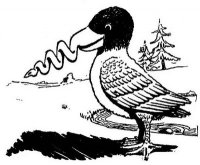
Swamp Augers (illustrated above) are only found from the Great Lakes to the Flordia Everglades. They do migrate South if the temperature begins to decrease for warmer waters by swimming down/up rivers (rarely flying).
Saturday, July 21, 2012
The Jubjub Bird: Beware!
In the deep, dark forests of Germany lives the dangerous bird known as the Jubjub. The Jubjub Bird is a large bird of prey that resembles a mixture between a vulture and a speckled chicken with a red head, long yellow beak, and a purple tongue. It's blood-chilling shrills can be heard from miles as the Jubjub goes out on the hunt of any prey that suites the bird's needs. Though rarely consuming humans, people must become aware whenever they hear the bird's terrifying screams because this species is large enough to take down a grown man without warning. Aggressive in nature, the Jubjub will attack any creature it chooses even if the other creature is larger then the bird itself (examples include dragons, brown bears, and grey wolves). The Jubjub bird is both an active hunter and a scavenger.
Jubjub Birds only nest in trees and are rarely found on the ground unless eating large animals such as elk or bear. They usually carry their prey back to their high up nests in tall trees to feast. The Jubjub is greatly feared by both humans and other creatures which make avoiding this creature completely while walking through areas these birds are known to live. The Jubjubs are known to live in small flocks if food supply is more abundant. Large males are usually the ones in charge of the flock but, females can be as well. If food supplies aren't abundant than normally, then the Jubjubs will be at each other throats and turn into solitary predators. They're known to be also cannibalistic during the winter as prey go into hibernation. Jubjub Birds are also found in some areas of Western Europe and in small Eastern regions of Russia's large forests.
 The Jubjub Bird (illustrated above) are quite ferocious and aggressive in the wild but, can be train into mild pets toward the bravest humans in the world. The Jubjub can become a great ally if you train it correctly.
Jubjub Birds only nest in trees and are rarely found on the ground unless eating large animals such as elk or bear. They usually carry their prey back to their high up nests in tall trees to feast. The Jubjub is greatly feared by both humans and other creatures which make avoiding this creature completely while walking through areas these birds are known to live. The Jubjubs are known to live in small flocks if food supply is more abundant. Large males are usually the ones in charge of the flock but, females can be as well. If food supplies aren't abundant than normally, then the Jubjubs will be at each other throats and turn into solitary predators. They're known to be also cannibalistic during the winter as prey go into hibernation. Jubjub Birds are also found in some areas of Western Europe and in small Eastern regions of Russia's large forests.

Subscribe to:
Posts (Atom)